Near-Death Experiences: Research Confirms Afterlife

Note:   For this introduction, I have drawn upon research of the eminent pioneers and current world leaders in the field of NDE research. Their books appear in the Science-Based Awakening Library after this introduction.

Woman Going to the Light During an NDE

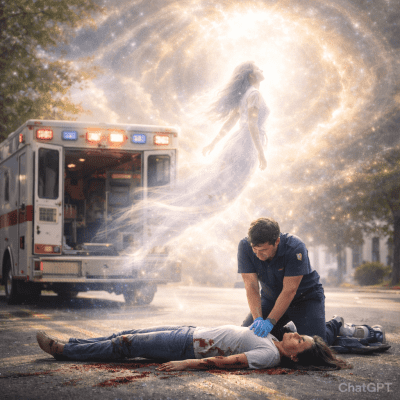
A near-death experience (NDE) is fundamentally a spiritual event that produces an intense awareness, sense, or experience of otherworldliness. An NDE can happen when a person’s physical body is deeply traumatized and close to death or is temporarily clinically dead. The trauma of dying and the vividness of NDEs make them highly memorable.

Conventional science maintains that a person’s brain produces consciousness. Therefore, it postulates that when a person dies, their consciousness ceases to exist. For example, the website of the Cleveland Clinic, among the top hospitals in the U.S., and worldwide, states: “Cardiac arrest happens because of an electrical issue that makes your heart stop beating. When your heart stops pumping blood, you become unconscious. [italics added for emphasis]” However, given that an NDE occurs when a person is physically unconscious and, in some cases, lacks any measurable brain activity, it certainly is not the brain that has the NDE.

Depending on the belief system of a person who has had an NDE (an NDEr), either their consciousness/awareness or their soul/spirit (their unique unit of consciousness or individuation) actually had the NDE. During their NDE, the person’s consciousness/soul exited temporarily from their physical body and flowed into their astral body. The astral body, which is composed of etheric, subtle matter, is a nonphysical replica of the person’s physical body, including their emotional and mental attributes.

Note:  A soul can be described as a tiny orb of energy and, also, as a unit of pure consciousness. It contains the memory of all of its experiences. Every soul is unique and is identifiable based on its vibrational frequency, just as people are identifiable based on their physical characteristics and psychological makeup.

Most NDEs are pleasant, but some are unpleasant. In his 2022 book, After, Bruce Greyson, M.D., Ph.D., states, “Among our current sample of experiencers, 86% said their NDE was primarily pleasant, 8% said it was unpleasant, and 6% said it was neither.”

This resource page contains the following sections:

Essential Elements of Near-Death Experiences

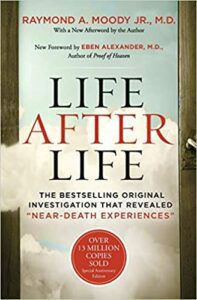
Research has identified a cluster of consistently reoccurring NDE elements—the essential elements, such that, a basic NDE model is widely accepted today. The premier list of essential elements was compiled by the pioneer NDE researcher, Raymond Moody, M.D., Ph.D., whose ground-breaking 1975 book, Life After Life, has sold over 13 million copies worldwide. Moody coined the term “Near-Death Experience” and has been called “the father of near-death experiences” by the New York Times.

Raymond Moody’s Essential NDE Elements

Each NDE is unique, but every NDEr experiences at least one of the following essential elements:

  • A sense/awareness of being dead
  • A sense of peace, well-being, and painlessness
  • An out-of-body experience (OBE)
  • Moving through a dark tunnel or passageway
  • Rapid movement toward and/or sudden immersion in a powerful light (or an encounter with a “Being of Light” that communicates with the person)
  • An intense feeling of unconditional love and acceptance
  • Reuniting with deceased loved ones (Encounters with the spirits of deceased relatives and/or friends have been conclusively proven.)
  • Receiving a panoramic life review
  • Approaching a border or a decision by oneself or others to return to one’s body, often reluctantly
  • Suddenly finding oneself back inside one’s body

Essential NDE Elements Are Unchanging across Time and Place

A few early written accounts of NDEs exist, and I am certain that humans had NDEs long before recorded history. However, NDEs were never formerly researched before Dr. Raymond Moody, Note that NDE accounts written prior to Moody’s research conform to his findings, as do those reported by subsequent researchers.

It is estimated by Dr. Bruce Greyson, a leader in the field of NDE research for over fifty years, that 5% of the world’s population has had an NDE. Global NDE studies show that hundreds of millions of people from diverse countries and cultures have reported one or more of the essential NDE elements. Although these elements remain constant worldwide, cross-cultural differences demonstrate that people interpret their experiences in terms of their own culture, whose concepts, images and symbols differ from those in the U.S. Moreover, the essential elements are universal regardless of a person’s age: NDE reports from young children, who would be unlikely to have expectations about death, report essential NDE elements.

Aftereffects of Pleasant NDEs

Spiritually, NDEs are of such magnitude that most experiencers are deeply affected, many to the point of changing their lives significantly. The aftereffects are often life-long and can intensify over time. For a summary of the positive psychological and behavioral aftereffects of NDEs, I have drawn upon the book Lessons from the Light by the esteemed psychologist and pioneer-researcher Kenneth Ring, Ph.D. (2024). He is the co-founder and past president of the International Association for Near-Death Studies (IANDS) and is the founding editor of the Journal of Near-Death Studies.

Kenneth Ring’s Positive NDE Aftereffects

  • Increased appreciation for life
  • Increased self-acceptance
  • Concern for others
  • Reverence for life
  • Anti-materialism
  • Anti-competitiveness
  • Elevated spirituality
  • A quest for knowledge
  • A sense of purpose
  • A vanquished fear of death
  • Belief in the afterlife
  • Belief in God

These positive aftereffects are similar to those identified by other NDE researchers. I recognize them as examples of life-changing spiritual transformations.

Unpleasant NDEs

Lists of NDE elements describe what are considered “pleasant” NDEs and are invariably positive. However, some NDEs are unpleasant. The primary difference is their emotional tone, with pleasant NDEs evoking positive emotions and unpleasant NDEs evoking negative ones: Pleasant NDEs are characterized by feelings of love, peace, joy, and connection, while unpleasant NDEs may involve fear, darkness, isolation, or even hellish landscapes. Despite emotional differences, some essential elements are shared by both pleasant and unpleasant NDEs, for instance, a sense of leaving the physical body and out-of-body experiences that can be experienced as either positive or negative.

The manner in which a person leads their life prior to their NDE has no bearing on whether they have a pleasant or unpleasant experience. Dr. Greyson states, “We don’t know why some people have distressing NDEs while others have blissful ones. It is not true, for example, that people who live ‘saintly lives’ always have pleasant experiences while ‘bad’ ones always have terrifying ones.”

The Benefits of Distressing NDEs

According to NDE researcher Dr. Barbara Rommer in her book about unpleasant NDEs, Blessing in Disguise, “It is tempting to think a ‘mean’ person will necessarily have a frightening or hellish experience and a gentle, kind person have a blissful experience … this is absolutely not the case.”

The aftereffects of unpleasant NDEs may initially be unsettling, but their long-term effects can be positively life-changing. According to Dr. Rommer, “As I accumulated more and more of the frightening ones [NDEs], certain patterns evolved. Profoundly positive life-altering changes occurred as a result of these frightening experiences, and those changes were sometimes even more significant and longer-lasting than those that occurred after pleasant NDEs.”

The more I research NDEs, the more apparent it is to me that both pleasant and unpleasant experiences are in service to spiritual growth.”
The president of the International Association for Near-Death Studies (IANDS), Dr. Jan Holden, concurs. During a 2025 podcast interview, Dr. Holden, who was lead editor of the Handbook of Near-Death Experiences: Thirty Years of Investigation (2009), was asked why NDEs happen. After stating that the answer she was about to give was not strictly based on research, she replied: “NDEs are facilitators of spiritual development.” Then, when asked specifically about distressing NDEs, she replied, “Some people need a distressing experience. At a spiritual level, there’s a wisdom about what’s known about what this person needs, and they get what they need. [italics added for emphasis]”

Holden’s perspective is affirmed by Dr. Rommer, “There are no trivial NDEs… A brief episode can cause as great a transformation as a longer, more complex one. What needs is what manifests. [Author’s Italics]”

The Implications of NDEs for Christian Teachings

Pleasant NDEs confirm the positive message of Christianity; they align with love and light. In contrast, the fear and hellscapes that typify unpleasant NDEs reflect man-made Christian dogma that postulates a future event when God or Christ will judge all the people who have ever lived for their deeds: The “righteous’” will receive “eternal life” in heaven; the “unrighteous” will receive “eternal punishment” in the fires of hell.

This section contains the following topics:

Pleasant NDEs Align with the Christian God of Love and Light

The Christian God of love and light and Jesus Christ as love are an inherent part of pleasant NDEs. The New Testament of the Bible, which many Christians believe is the inerrant word of God, declares that God is love and light: In 1 John 4:8, “God is love,” and in John 1:5, “God is light, and there is no darkness in him.” Based on these passages, God, the Creator of the universe, is love and light. This is my inner knowing as well: God is love and light.

The God of love and light is inherent in many pleasant NDEs. This is expressed by two of Raymond Moody’s essential elements:

  • A rapid movement toward and/or sudden immersion in a powerful light (or an encounter with a “Being of Light” that communicates with the person)
  • An intense feeling of unconditional love and acceptance

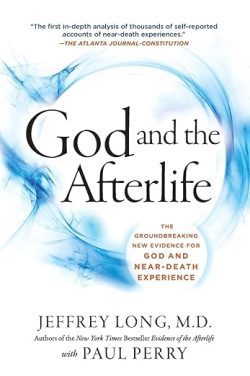
In his most recent book, God and the Afterlife, New York Times bestselling author Jeffrey Long, M.D., a cofounder of the Near-Death Experience Research Foundation (which hosts the website with the largest number of researched NDEs), writes:

Confounding description even more is the all-inclusive nature of the lovethese explorers felt. They describe this love as being the very essence of GodITALICS. Hence, it is the very essence of all reality, the cosmos, life, all things. It is our essence. The light, or energy, behind all creation is or consists of love. That is what NDErs are describing when they talk about the universal love and unity that takes place during their experience… [italics added for emphasis]

Jesus Blessing an NDEr

Jesus Christ as love is an inherent part of many pleasant NDEs. NDErs have often reported meeting and communicating with a being that they identified as Jesus Christ, whom they have all described as an unconditionally loving being. So, the Christian God of love and light and Jesus Christ as love are an inherent part of NDEs.

There Is No Evidence of a Judgmental, Punishing God

The Christian dogma of heaven versus hell is a core belief of the nearly two-thirds of American adults who identify as Christian. According to a 2023 Pew Research Center report, of the 83% of Americans who believe they have a soul, a significant percentage believe in heaven (71%) and hell (61%).
The dogma of heaven versus hell depends on the notion that errant souls may be punished by God. But, in all my afterlife research, there is not a single shred of evidence of the judgmental, punishing God described in the Christian Bible (where the word “sin” and its variations appear over 600 times and “shame,” over 400 times). Furthermore, the vast majority of NDEs, characterized by love, light, and non-judgment, actively undermine this fear-inducing dogma.

According to Dr. Jeffrey Long, “I cannot recall any description in NDEs of God using power to harm any being. This should not be surprising given that in NDEs, God is typically described as profoundly loving… it’s the power of love that stands out in so many of the case studies. (God and the Afterlife)

In his book Soul and Destiny, Alan Cohen, the bestselling author of over 30 books, considers how the unfounded concept of the judgmental, punishing God came to be:

Many religions and cultures are masters of manipulation. They have figured out that if you can make a person afraid or guilty, you can control them. If religions deleted fear-based rules, there would not be much left of the religion. True religion is founded in love. Controlling through threat of a horrid afterlife is very convenient because the afterlife is a mystery to those yet to enter it. It’s easy to project morbid stories onto the blank screen of the unknown.

For my in-depth research exposing the false dogmas of sin and hell, see the following chapters of my free online book Unveiling Christianity:   Original Sin, History of Heaven and Hell, and Christianity: Religion of Fear and Hope.

Life Reviews Radiate Non-Judgment

“The Last Judgment” (Victor Vasnetsov, 1904)

Raymond Moody’s list of essential NDE elements includes “Receiving a panoramic life review.” This may be the most important NDE element, for life reviews refute the existence of a judgmental, punishing God. They pinpoint the fundamental difference between essential NDE elements and the Christian belief in Divine Judgment.

Based on reports by NDErs, a life review is a vivid and comprehensive review of one’s life. The life review is not merely a recollection of events; it includes experiencing the impact of the NDEr’s actions on others, both positive and negative. A life review unfolds in the loving presence of one or more light-filled Beings, who are unconditionally loving and non-judgmental.

Below, I summarize the key spiritual aspects of a typical life review:

  • Loving guidance: An unconditionally loving Being assists the individual during the life review.
  • A comprehensive and vivid experience: The review is not a quick montage but, rather, a detailed and immersive experience that replays every event from the individual’s life in great detail.
  • Emotional impact on others: NDErs report experiencing the emotions of others involved in their life events, such as their joy and suffering.
  • Impact of one’s actions: A life review often highlights the consequences of the person’s actions, emphasizing the ripple effect their choices had on others.
  • (Optional) Self-judgment: Many individuals report experiencing self-judgment and remorse for missed opportunities to be kinder or more helpful. However, self-judgement is solely at their own discretion.
  • No external judgment: Though, self-evaluation and self-judgment might arise, there is no sense of an external judge or judgmental deity.
  • Potential for transformation: Life reviews can lead to profound changes in behavior, such as increased empathy and altruism and a decreased focus on material possessions.

To gain an appreciation of the direct experience of life reviews and garner fresh insights into them, it is invaluable to read the accounts of NDErs who have had one. Here are a few enlightening quotations from people whose NDE life reviews appear in the 2022 book Crossover Experience: Life after Death, a New Perspective:

  • “I did find out about the so-called ‘Judgment Day’ I feared so much as a child. We judge ourselves and that it first was a big relief, but our life is still our job. …I was shown in living color, like on a movie certain situations, both good and bad, in my life. I was able to see and hear exactly as it was. …I was with a Being made out of the brightest white light I have ever been able to look at without hurting my eyes.” — Glenda H.
  • “Through the panoramic life review I had been given the knowledge of how to correct my life, and how to use the power of love to make a difference in the world.” — Mike M.
  • ”I was shown incidents in my life where I was very mean to people or hurt people without realizing it due to self-absorption or distraction. …When he showed me all these things he did not condemn me but showed me all of the last moments of love and how it had a domino effect on others. He was so loving in all of this conviction.” — Katie W.
  • “I could gauge and feel the impact of my decisions, and how these actions affected other’s lives. There were no feelings of guilt or remorse, only the knowledge that I could have done things differently in some of the situations. There was no blame, no remorse, and no feelings of guilt. …Love is all that I could feel.” — Mike M.
  • “I met a glowingly beautiful, very loving being. …I knew that I knew him, and felt completely comfortable and happy. His loving presence completely surrounded me, and together we went through my life and all that I experienced in a loving way, not any judging way.” — L. Bolette

Scientific Evidence of NDEs Debunks Scientific Materialism

With few exceptions, conventional science postulates that only the material world exists. This is a widely accepted paradigm known as scientific materialism (or physicalism). A central proposition of scientific materialism is that consciousness is produced by the brain so that when a person dies their consciousness ceases to exist. This proposition has never been proven to be true, nor will it ever, for it is clearly refuted by the NDE phenomenon.

In the following two sections, I consider the perspectives of two leading NDE researchers:

AWAreness during REsuscitation Study (AWARE-II)

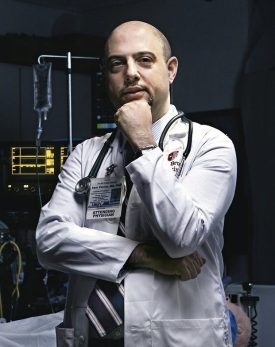
Sam Parnia in Attending Physician lab coat with stethoscope
Sam Parnia

In addition to rich anecdotal evidence about NDEs, scientific evidence is accumulating. Sam Parnia, M.D., Ph.D., a professor of medicine with a Ph.D. in cell and molecular biology, is an international leader in the field of cardiopulmonary resuscitation and, also, in scientific research on the near-death experience. Dr. Parnia was the lead scientist and director of the second AWAreness during REsuscitation study (AWARE-II), the largest and most comprehensive study of the human mind, consciousness, and brain activity during cardiopulmonary resuscitation (CPR).

This first-of-its-kind study represented a collaborative effort among twenty-five major medical centers, primarily in the U.S. and U.K., and thirty-three leading scientists and medical specialists in intensive care, medicine, neurophysiology, neurology, and anesthesia. This was the first time during CPR that scientists incorporated tests of consciousness, as well as using brain monitoring systems, to look into the brains of people who were actively being revived back to life after cardiac arrest.

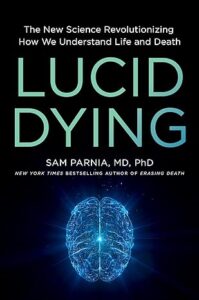
The research team summarized its findings in an article in the scientific journal Resuscitation Vol. 191, October 2023), “AWAreness during REsuscitation – II: A multi-center study of consciousness and awareness in cardiac arrest.” Dr. Parnia summarized AWARE-II findings in his New York Times bestselling book, Lucid Dying (2024), which is the source of this discussion. The AWARE-II study found that one in five survivors of CPR after cardiac arrest had features of a “recalled experience of death” (RED), Parnia’s term for “near-death experience.”

Parnia’s team systematically analyzed RED testimonies using a scientific technique called grounded theory. This is a specialized research method that allows scientists to develop explanations for observations based on data that has been systematically gathered and analyzed, instead of mere speculation. Using this method, and drawing upon Moody’s ten essential NDE elements, Parnia identified around forty unique and consistent universal themes that characterized recalled experiences of death.

In order to compare the results of the AWARE-II study with industry standard NDE elements, Dr. Parnia drew upon the ground-breaking research in Raymond Moody’s Life after Life. Dr. Parnia condensed Moody’s essential NDE elements into seven positive core themes. These are: (1) separation from the body, (2) a review of life, (3) travel to a destination, (4) arriving at a beautiful place, (5) encountering a bright and warm loving light, (6) seeing a luminous, compassionate being, and (7) the decision to return to the body. Parnia compared the results of the AWARE-II study with these seven core components. He reported on the results of the AWARE-II research in Scientific American, “Lifting the Veil on Near Death Experiences” (May 14, 2024), among other publications from around the world.

According to Dr. Parnia:

The AWARE-II study changed what it means to be on the brink of death and in a coma. …in our accumulation of studies of thousands of firsthand testimonies from people who enter the proverbial ocean of death, they describe journeying into a state of hyperconscious, lucid thought processes that they experience without fear or distress. In our AWARE-II study we measured electrical signs of lucid and heightened brain activity, and these, together with similar stories of recalled death experiences, strongly suggest that the human sense of self and consciousness, much like other biological body functions, is not annihilated when people enter the ocean of death and traverse beyond the traditional threshold of death. We also found this experience to be different from imaginary experiences, such as hallucinations, delusions, illusions, and dreams, as well as CPR-induced consciousness. These results—and the suggestion that our brains have one last surprise in store for us, and that there may be an experience beyond that which we may expect, and even more astonishingly, that this concept holds up to scientific rigor and inquiry—were quietly ground shaking.

Along with my extensive research into spirituality, the results of the AWARE-II study and my other NDE research has led me to unconditionally conclude that consciousness (the soul) survives the death of the body. For more information, see the following BeAwake.com resources pages: Unbounded Consciousness, Out-of-Body Experiences, Reincarnation, Mediumship, and Direct After-Death Communication.

Parnia’s Life-Review Elements

Based on his NDE research with cardiac arrest survivors that experienced a life review, Dr. Sam Parnia created the following detailed list of frequently reported life review elements. This informative list stands alone as the most detailed list of its kind.

  1. Reviewing a recording of life. Nothing appears hidden—all thoughts, intentions, actions, inner states, and emotions throughout life appear to have been grounded and stored in a person’s consciousness and are recognized to have mattered.
  2. The indescribable. Being in the presence of a compassionate, loving, “perfect” and luminous being.
  3. Hierarchy of knowledge. People recognize higher levels of knowledge and wisdom, which relate to having higher fields of perception to understand those truths.
  4. Whatever good and whatever harm that I have done was to myself. People recognize that harming others ultimately reflects back on the person themselves and vice versa.
  5. Relive life events and experience each moment. Specifically, people are able to re-experience themselves in all events in their life from the most mundane to the most extreme.
  6. Need to do better: not as good as I thought. People come to judge their true worth as a human being based on the principal of ethics and morality. They recognize their purpose in life had been to improve themselves as a true human being.
  7. Being in other’s shoes. People examine their experiences in life from multiple perspectives, including those of the people they affected.
  8. Evaluation of actions and inactions in life. Not only actions are evaluated but also at times when people could have done something positive for others but did not.
  9. Domino effect. This effect reveals the impact and downstream consequences of people’s actions – both good and bad—on people’s lives. They appreciate, as one person said, “how big an impact my seemingly small actions had on a big scale.”
  10. A different value system. People discover that seemingly insignificant actions in ordinary life, such as giving someone a helping hand, have been far more valuable than many of the things that people (and society) present as being important.
  11. A reason and cause and effect underlying all events. People appreciate that everything that has happened during their ordinary day-to-day life had a reason. Specifically, they recognize that the principal of cause and effect, which governs everything else in existence and is the cornerstone of science, also applies to events in their lives.
  12. Higher overall purpose in life. People wished they had understood and appreciated their higher purpose throughout their lives, so they could have lived their life more meaningfully and shaped their destiny better. As one person said, “I saw that I alone am in charge of my destiny.”

Dr. Parnia concludes this list of Life Review elements, “Overall, there is a recognition that life had comprised an education, with the purpose of helping people gain knowledge about how to improve as a human being. [Dr. Parnia’s italics]”

Scientific Materialism Cannot Readily Explain NDE Data

According to Bruce Greyson in 2013 “Getting Comfortable With Near Death Experiences: An Overview of Near-Death Experiences” (in the Near-Death Experiences & Consciousness By Bruce Greyson NIH NDE report):

“Some of the phenomenological features of NDEs are difficult to explain in terms of our current understanding of psychological or physiological processes. For example, experiencers sometimes report having viewed their bodies from a different point in space and are able to describe accurately what was going on around them while they were ostensibly unconscious; or that they perceived corroborated events occurring at a distance outside the range of their sense organs, including blind individuals who describe accurate visual perceptions during their NDEs.

“Furthermore, some NDErs report having encountered deceased relatives and friends, and some child NDErs describe meeting persons whom they did not know at the time of the NDE but later identified as deceased relatives from family portraits they had never seen before. Other experiencers report having encountered a recently deceased person of whose death they had no knowledge, making expectation a highly implausible explanation. These aspects of NDEs present us with data that are difficult to explain by current physiological or psychological models or by cultural or religious expectations.

Bruce Greyson, M.D., Ph.D.

“These features and the occurrence of heightened mental functioning when the brain is severely impaired, such as under general anesthesia and in cardiac arrest, challenge the common assumption in neuroscience that consciousness is solely the product of brain processes or that mind is merely the subjective concomitant of neurological events.”

For additional information from Dr. Bruce Greyson about NDEs and consciousness, I recommend the following video presentation sponsored by the International Association of Near-Death Studies (IANDS): Why NDEs Matter: The Science of Consciousness Beyond Death.

NDEs Compared to Permanent Physical Death

I have long been absorbed by the topic of reincarnation—the living of multiple physical lives by a given soul. Reincarnation enables each person’s eternal soul to have as many lifetimes as it chooses.

Souls choose to incarnate again and again in order to grow in love and in wisdom based on what they have chosen to learn in each of their lifetimes. There is no punishment, and the only judgment that may occur is self-judgment that arises only if a person’s consciousness/soul judges their actions or inactions during their lifetime. Sometime after permanent physical death, when a person’s consciousness/soul has fully transitioned to the higher nonphysical realms, a new cycle of reincarnation begins, a new incarnation begins.

A soul, having free will, chooses whether to begin incarnating. It knows that if it incarnates, its cycle of reincarnation will continue until it realizes its true nature during a physical incarnation.

Evidence supporting the existence of reincarnation has escalated in the recent past. That evidence, combined with the glimpses provided by near-death experiences, gives us insights into what happens after physical death. In this section, I summarize, first, the similarities between NDEs and permanent death and, then, based on my extensive reincarnation research, between the cycle of reincarnation and NDEs.

Time Is an Illusion:  We experience time as a linear, flowing, and absolute force, but quantum physics shows otherwise. Actually, time does not exist in the way we think; it is merely a mental construct, a limitation of human consciousness trying to process reality. Albert Einstein famously noted that the distinction between past, present and future is only a “stubbornly persistent illusion.” Quantum mechanics has demonstrated that time is not an underlying, fundamental feature of the universe. Rather, everything is happening now. Therefore, all incarnations exist simultaneously; that is, multiple, incarnations all exist at the same “time.” Since the “re” in reincarnation means “again,” in actuality, “re-incarnation” does not exist because nothing happens “again.”

This means that the implied time flow in the following summaries is not real, but, it accommodates our concept of linear time. For this reason, I am comfortable with the term “reincarnation,” which is the commonly accepted term for a soul’s multiple incarnations.

The following NASA space news video Time Is an Illusion: Scientists Say Time Doesn’t Exist in the Way We Think explains this perplexing aspect of reality.

Similarities Between NDEs and Permanent Death

Note:  The time flow implied in the following table accommodates our concept of linear time.

texthere

Similarities Between the Cycle of Reincarnation and NDEs

Note:  The time flow implied in the following table accommodates our concept of linear time.

texthere

texthere

texthere

In Conclusion

NDEer Observing Surgery on His Body

Note:  For more information about reincarnation, see my Reincarnation resource page.

Many early Christians believed in reincarnation. But the emerging Roman Catholic Church rejected reincarnation in favor of the contrary dogma that a soul has only one lifetime followed by judgment from an external God, who, depending on the person’s deeds and beliefs, grants their soul “eternal life” or “eternal punishment.” Nevertheless, several passages in the Christian Bible’s New Testament validate reincarnation (for more information, see Reincarnation as Revealed in the Bible in my free online book, Unveiling Christianity).

Near-death experiences are spiritual experiences. This is exemplified by the amazing ways many NDErs dramatically change their values and their lives, as evidenced by Kenneth Ring’s list of positive aftereffects of NDEs. Over the past half century, a vast amount of formal research on NDEs worldwide has shown that they confirm the reality of an afterlife and actually provide evidence of our eternal nature as consciousness/soul.

Positive NDE accounts resoundingly debunk the widely held Christian belief of a “final judgment” (the “Second Coming”). In research on NDEs, no evidence of external judgment occurs, and there is no evidence that validates the core Christian teaching of a system of reward and punishment.

To the contrary, the presence of light and love is frequently reported by NDErs, and reports by those meeting Jesus Christ always describe him as a totally loving being without judgment, without punishment. Indeed, several of Raymond Moody’s essential NDE elements describe immersion in the Source of Creation or God: (1) “A sense of peace, well-being, and painlessness,” (2) “A rapid movement toward and/or sudden immersion in a powerful light (or an encounter with a ‘Being of Light’ that communicates with the person),” and (3) “An intense feeling of unconditional love and acceptance.”

Human incarnations are designed to teach aspects of love. Given the spiritual maturation that souls achieve through their cycles of reincarnation, earth is sometimes referred to as a school or classroom for souls. NDE life reviews reveal that souls are never punished for anything, ever. The life review is merely a teaching mechanism for a soul to learn from its incarnation. It is an unconditionally loving experience; feeling guilt or shame is solely the soul’s choice. After a soul’s life review of its latest incarnation and subsequent cleansing and healing, it returns “Home” to the higher realms of peace, love, joy, and harmony.

Note:   For resources about NDEs, see the Science-Based Awakening library, below. For those interested in the origin and effects of Christian teachings that may be considered controversial, see my free online book Unveiling Christianity.

science-based awakening resources

texthere

Near-Death Experience Resources

Organizations

  • International Association for Near-Death Studies (IANDS)

    IANDS is a membership-based group whose focus is to provide the highest quality information available on NDE-related subjects. In addition to maintaining their information-rich website, IANDS publishes a peer-reviewed scholarly journal and member magazine, sponsors conferences and other programs, works with the media, and encourages the formation of regional discussion and support groups.

  • Near-Death Experience Research Foundation  (NDERF)

    The NDERF web site is a free public service that welcomes and encourages all people of all backgrounds, nationalities, countries, and religions to read and participate. NDERF’s mission is to research and study consciousness experiences and to spread their message of love, unity and peace around the world.

Video Presentations

Articles on BeAwake.com

Books about Near-Death Experiences

Note:  Book titles are linked to amazon.com, which offers numerous book reviews.

Alexander, Eben, M.D.

Proof of Heaven: A Neurosurgeon’s Journey into the Afterlife
by Eben Alexander, M.D., 196 pages (2012) 

A New York Times bestseller. According to Raymond A. Moody, M.D., Ph.D., author of Life After Life, “Dr. Eben Alexander’s near-death experience is the most astounding I have heard in more than four decades of studying this phenomenon. He is living proof of an afterlife”.

Atwater, P.M.H., L.H.D.

The Forever Angels: Near-Death Experiences in Childhood and Their Lifelong Impact
by P.M.H. Atwater, L.D.H., 231 pages (2019)

Atwater is a pioneer in NDE research and has done exhaustive research over 40 years. She had three NDEs.

Beyond the Light: What Isn’t Being Said About Near-Death Experience (Revised Edition)
by P.M.H. Atwater, L.D.H., 279 pages (1994 and 2009)

Chapter three in this book describes distressing NDEs. Atwater concludes that fear is the causal factor “in every single case” of these purely subjective experiences. She writes that some adults have distressing experiences while children do not. She believes that the psyche uses these distressing experiences as confrontations of one’s shadow, making them a mechanism for healing and growth.

Bachrach, Judy

Glimpsing Heaven: The Stories and Science of Life After Death
by Judy Bachrach, 249 pages (2014)

The author is a journalist who interviewed leading NDE experts and some of the most well-known NDE experiencers, some of whom are featured in books in this section. 

Batthyany, Alexander

Foundations of Near-Death Research: A Conceptual and Phenomenological Map
edited by Alexander Batthyany, 355 pages (2018)


Brinkley, Dannion and Brinkley, Kathryn

Secrets of the Light: Lessons from Heaven
by Dannion Brinkley and Kathryn Brinkley, 205 pages (2008) 

This book is a New York Times bestseller.

Bush, Nancy Evans, M.A.

Reckoning: Discoveries after a Traumatic Near-Death Experience
by Nancy Evans Bush, MA, 239 pages (2021)

The author was the Executive Director and later President of the International Association for Near-Death Studies (IANDS) and a member of the Board of Directors for many years. She is frequently referred to as the world expert on distressing NDEs. 

Dancing Past the Dark: Distressing Near-Death Experiences 
by Nancy Evans Bush, MA, 289 pages (2012)

Coppes, Robert Christopher, Ph.D.

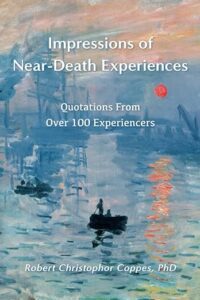
Impressions of Near-Death Experiences: Quotations from Over 100 Experiencers 
by Robert Christopher Coppes, Ph. D., 247 pages (2023)

This book describes people from many cultures and religions from around the world who share fascinating and inspiring Near-Death Experiences that transcend their religions and cultures. The author lives in Amsterdam, the Netherlands. Impressions of Near-Death Experiences is published by the International Association of Near-Death Studies.

Doty, James R., M.D.

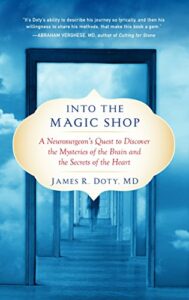
Into the Magic Shop: A Neurosurgeon’s Quest to Discover the Mysteries of the Brain and the Secrets of the Heart 
by James R. Doty, M.D., 276 pages (2016) 

This book is a New York Times bestseller.

Fenwick, Peter, M.D., and Fenwick, Elizabeth

The Truth in the Light: An Investigation of Over 300 Near-Death Experiences 
by Dr. Peter Fenwick and Elizabeth Fenwick, 278 pages (1995)

He is the President of the British branch of the International Association for Near-Death Studies.

Greyson, Bruce, M.D.

After: A Doctor Explores What Near-Death Experiences Reveal about Life and Beyond
by Greyson, Bruce M.D., 258 pages (2021)

This book is a scientific exploration of NDEs by the world’s foremost expert on NDEs. Greyson has been called the father of research in NDEs and has been a leader in this field for over fifty years.

Hagan, John C. III, M.D.

The Science of Near-Death Experiences 
edited by John C. Hagan III, M.D., 169 pages (2017)

Each chapter is authored by one of the leading NDE experts, most of whom have books that appear on this list of references.


Holden, Janice Miner, EdD., and Greyson, Bruce, M.D.

The Handbook of Near-Death Experiences: Thirty Years of Investigation
by Janice Miner Holden, EdD., Bruce Greyson, M.D., Debbie James, MSN, RN, editors, and many contributors, 313 pages (2009)

This book is the standard reference work in the field. It contains scholarly aspects of NDE research.


Kadagian, DJ; van Lommel, Pim, M.D.; and Shushan, Gregory, PhD

The Crossover Experience: Life After Death / A New Perspective
by DJ Kadagian, Dr. Pim van Lommel, and Gregory Shushan, PhD, 348 pages (2022)

DJ Kadagian is an award-winning documentary film-maker, best-selling author, and quantum economist. Co-authors Pim van Lommel and Gregory Shushan are pioneers and leading experts in NDE research. For this book, the authors researched and analyzed thousands of the most exceptional NDEs ever recorded. We highly recommend this book as a comprehensive overview of the subject.


Long, Jeffrey, M.D.

Evidence of the Afterlife: The Science of Near-Death Experiences
by Jeffrey Long, M.D., with Paul Perry, 215 pages (2010)

This book is a New York Times bestseller. It was the largest NDE study ever conducted, this provides the most compelling evidence for life beyond death ever compiled.

Lundahl, Craig, Ph.D., and Widdison, Harold A., Ph.D.

The Eternal Journey: How Near-Death Experiences Illuminate Our Earthly Lives
by Craig R. Lundahl, Ph.D. and Harold A. Widdison, Ph.D., 294 pages (1997) 

This is a very well researched, readable, and comprehensive book on NDEs.


Moody, Raymond, M.D., Ph.D.

The Light Beyond: The Extraordinary Sequel to the Classic Bestseller Life after Life
by Raymond A. Moody, M.D., Ph.D., 186 pages (1988)

Moody is the New York Times best-selling author who coined the term, “Near-Death Experience.”

Life After Life: The Bestselling Original Investigation That Revealed “Near-Death Experiences”
by Raymond A. Moody, M.D., Ph.D., 176 pages (1975)

A bestselling original Investigation, this study coined the term “Near-Death Experience.” Over 13 million copies have been sold.

Moody, Raymond, M.D., Ph.D., with Perry, Paul

Glimpses of Eternity: Sharing a Loved One’s Passage from This Life to the Next
by Moody, Raymond M.D., Ph.D., with Perry, Paul, 166 pages (2010)

Morse, Melvin, M.D., with Perry, Paul

Closer to the Light: Learning from the Near-Death Experiences of Children
by Melvin Morse, M.D., with Paul Perry, 236 pages (1990) 

This book was a New York Times bestseller.

Website:    MelvinMorseMD.com

Parnia, Sam, M.D., Ph.D.

Lucid Dying: The New Science Revolutionizing How We Understand Life and Death 
by Sam Parnia, M.D., Ph.D., 341 pages (2024)

Dr. Parnia directs the AWARE Study (Awareness During Resuscitation).

Parnia, Sam, M.D., Ph.D., with Young, Josh

Erasing Death: The Science That is Rewriting the Science Between Life and Death 
by Sam Parnia, M.D., Ph.D., with Josh Young, 344 pages (2013)

New York Times bestseller

Ring, Kenneth, Ph.D.

Heading Toward Omega: In Search of the Meaning of the Near-Death Experience
by Kenneth Ring, Ph.D 347 pages (1984)

Kenneth Ring is co-founder and past president of the International Association for Near-Death Studies (IANDS) and founding editor of  The Journal of Near-Death Studies.

Life at Death: A Scientific Investigation of the Near-Death Experience
by Kenneth Ring, Ph.D., 310 pages (1980)

“If one person can claim to be an authority on near-death experiences without having had one, that person must surely be Kenneth Ring…And more importantly, no other researcher has been able to transmit to the rest of us the true meaning and impact of near-death phenomena for the planet.” – Bruce Greyson, M.D., Past-President of the International Association for Near-Death Studies (IANDS)

Ring, Kenneth, Ph.D., and Cooper, Sharon

Mindsight, Second Edition, Near-Death and Out-of-Body Experiences in the Blind
By Kenneth Ring, Ph.D. and Sharon Cooper, 156 pages (2008)


Ring, Kenneth, Ph.D., and Valarino, Evelyn Elsaesser

Lessons from the Light: We Can Learn from the Near-Death Experience
by Kenneth Ring, Ph.D., and Evelyn Elsaesser Valarino, 340 pages (2000) 

Ritchie, George G., MD, PhD.

Return from Tomorrow
by George G. Ritchie, MD, PhD., 124 pages (1978, 1996)

“This chronicle is one of the most well-documented dying experiences known to me.” — Raymond S. Moody M.D., Ph.D.


Rivas, Titus, MA, MSc, and Dirvan, Anny

The Self Does Not Die: Verified Paranormal Phenomena from Near-Death Experiences
by Titus Rivas, MA, MSc, Anny Dirvan, and Rudolf H. Smit, 362 pages (2016) 

Published by the International Association for Near-Death Studies (IANDS)

Rommer, Barbara R., M.D.

Blessings in Disguise: Another Side of the Near-Death Experience
by Barbara R. Rommer, M.D., 207 pages (2000)


Sartori, Penny, Ph.D., RGN

The Wisdom of Near-Death Experiences: How Understanding NDEs Can Help Us Live More Fully 
by Penny Sartori, Ph.D., RGN, 236 pages (2014)

This book is a bestseller and has been translated into twelve languages.

Website:   DrPennySartori.com

Thornton, Rosemary

Remembering the Light: How Dying Saved My Life 
by Rosemary Thornton, 232 pages (2021)

An inspirational account of author’s life after her husband committed suicide, followed by her cancer, NDE, and recovery.

Tolman, Vincent Todd with Taylor, Lynn

The Light after Death: My Journey to Heaven and Back 
by Vincent Todd Tolman with Lynn Taylor, 162 pages (2022)

van Lommel, Pim, M.D.

Consciousness Beyond Life: The Science of the Near-Death Experience 
by Pim van Lommel, M.D., 442 pages (2010)

Dr. van Lommel is a world-renowned cardiologist and medical expert on NDEs from the Netherlands.